


Discover the renewed digital presence of India International Centre - designed for deeper engagement and seamless access.

Climate Change—Land Use—Biodiversity Nexus (Group: Science & Technology)

Kitchen Stewarding Supervisor – 01 Post (FTC basis)

The eligibility criteria for submitting applications are as follows: 

a)    Qualification

Graduate with 1 year Diploma / Certificate course in Kitchen Management/ kitchen Stewarding/ Food Service Management


b)    Responsibilities

•    Supervision, monitoring and training of kitchen stewards / utility staff including yearly FSSAI and other periodical trainings.
•    Cleanliness & Sanitation: Maintain cleanliness and sanitization of all kitchens, storage, and waste areas in compliance with the food safety regulations.
•    Kitchen hygiene: To ensure high level of hygiene in all kitchen areas.
•    Equipment & Dishwashing: Proper cleaning of all kitchen equipment’s and ensure that it is well maintained. Daily temperature recording of all cold storage.
•    Inventory Management: Manage Inventory of Kitchen cleaning supplies and equipments..
•    Waste Management: Oversee the proper segregation, storage, and timely disposal of kitchen garbage in compliance with the instructions of municipal authorities.
•    Pest Control and Fumigation: Keep a weekly/ regular track of fumigation and ensure all cooking areas are pest free.
•    Cross Department Coordination: Liaise with the other departments for implementation of mandatory compliances.
•    Ensure COSHH (Control of Substances Hazardous to Health) and safe handling of commercial cleaning chemicals is done properly.


c)    Experience

3 to 5 years of experience in stewarding section of a reputed hotel/resort/restaurant with at least 1 year in a supervisory capacity.

d)    Age

25 – 35 Years*

e)    Remuneration     

Monthly remuneration Rs.50,000/- 

*Relaxable in case of deserving candidates


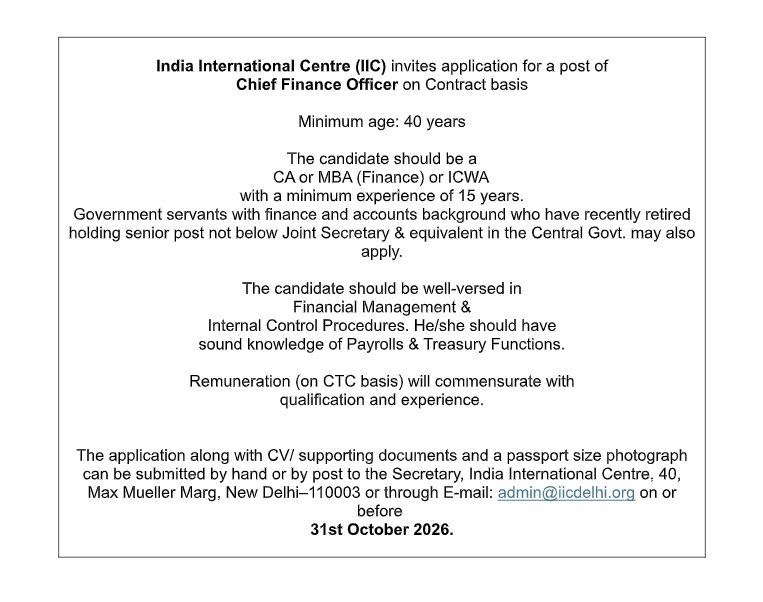
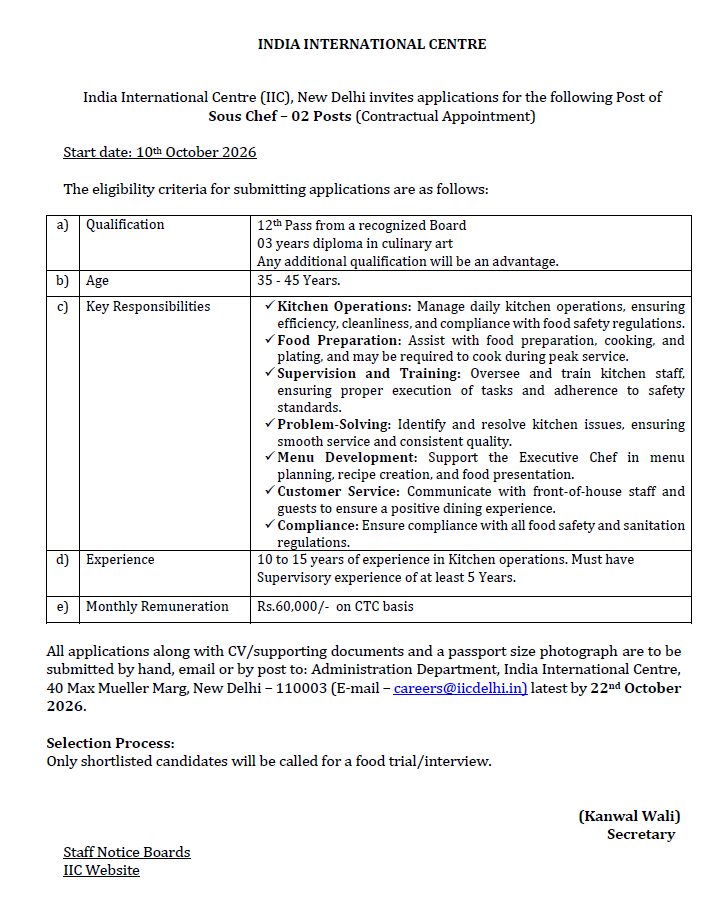
All applications along with CV/supporting documents and a passport size photograph are to be submitted by hand, email or by post to: Administration Department, India International Centre, 40 Max Mueller Marg, New Delhi – 110003 (E-mail – careers@iicdelhi.in) latest by 03.08.2026.


The Democracy to Come-Ambedkar, Fanon, and the Time of Counter-Revolution

The Democracy to Come

Ambedkar, Fanon, and the Time of Counter-Revolution  

Speaker: Dr Aishwary Kumar, Professor of History of Political Thought and Institutions, and Director of The Democracy Institute at Cal Poly Pomona, Chair, The GIFT Project and the American Institutions Common Core

Chair: Dr Mujibur Rehman, faculty, Jamia Millia Central University, New Delhi

Introductory Remarks: Dr Usha Munshi, Chief Librarian, IIC

The concept of “counter-revolution” occupies a galvanizing place in B. R. Ambedkar’s political thought and moral psychology. Unlike nationalists of his time, Ambedkar rarely speaks of extreme violence and exploitation as a function simply of modern colonial bondage. Instead, for him, “inequality” is force, a spectrum of compulsions, a desire even. Which is why its cruelty can be grasped only as a counter-revolutionary form that alters our very relationship to time and authority. Counter-revolution as a neo-democratic form: this singular insight—what I call "the caste contract"—puts Ambedkar in an exemplary constellation of abolitionist thinkers on human freedom and moral judgment who return to us today with a dark urgency.


Climate Change and Sustainability

Climate Change and Sustainability

Climate Change and Sustainability

Speaker: Shyam Saran, President, IIC

Inaugural Remarks: Anil Rajput, Chairman, Bharat Ki Soch

Closing Remarks: RK Pachnanda, Director Bharat Ki Soch

The talk will examine the evolving challenges of climate change and sustainable development, with a focus on environmental diplomacy, ecological resilience, and policy responses. It will consider how governments and institutions can work towards balancing development with environmental stewardship.


This session is a part of the flagship discussion series, 'Mantraṇā'. Derived from the ancient Sanskrit lexicon, Mantraṇā signifies strategic, high-level deliberation and institutional counsel aimed at addressing contemporary governance and security imperatives. Serving as a dedicated platform where policymakers, academics, and domain experts converge to distill complex global challenges into actionable policy pathways.

(Collaboration: Bharat Ki Soch (BKS)


CONSTRUCTION & FABRICATION OF MILD STEEL RAILING & BLUE STONE BOUNDARY WALL


   TENDER


CONSTRUCTION & FABRICATION OF MILD STEEL RAILING & BLUE STONE BOUNDARY WALL

    INDIA INTERNATIONAL CENTRE
         40, MAX MUELLER MARG   
   LODHI ESTATE,  NEW DELHI


Tender for Construction & Fabrication 

Drawings:

  1. Gandhi King Plaza
  2. Gandhi King Plaza Boundary wall 


Performance - Rhythms of Maharashtra: Lavani & Jogwa

Still Exceptional? India's Democracy in Comparative and Historical Perspective

Why are Indian elections so unpredictable?

Why are Indian elections so unpredictable?

Why are Indian elections so unpredictable?

Speaker: Pradeep K Chhibber, Professor of Political Science and Indo-American Community Chair in India Studies at the University of California, Berkeley. US

Moderator: Rahul Verma, Associate professor of political science at the Law School, Shiv Nadar University and Fellow at Centre for Policy Research (CPR)

Discussants: Barkha Dutt, Senior Journalist and Founder MoJo Story; Roshan Kishore, Political Economy and Data Editor, Hindustan Times

Indian elections continue to surprise us. While caste, religion, and community remain central to Indian politics, frequent electoral swings and shifting party loyalties reveal that identity alone cannot explain voting behaviour. Drawing on village-level election data, national surveys, and extensive fieldwork, the discussion shall reflect on the nature of weak party organization and over dependence on local influencers which results in the under-mobilization of poorer voters. This creates a "reciprocity trap" that binds parties and local elites together, leaving many citizens beyond the reach of party politics during elections.

(Collaboration: Centre for Policy Research (CPR)


Subscribe to